
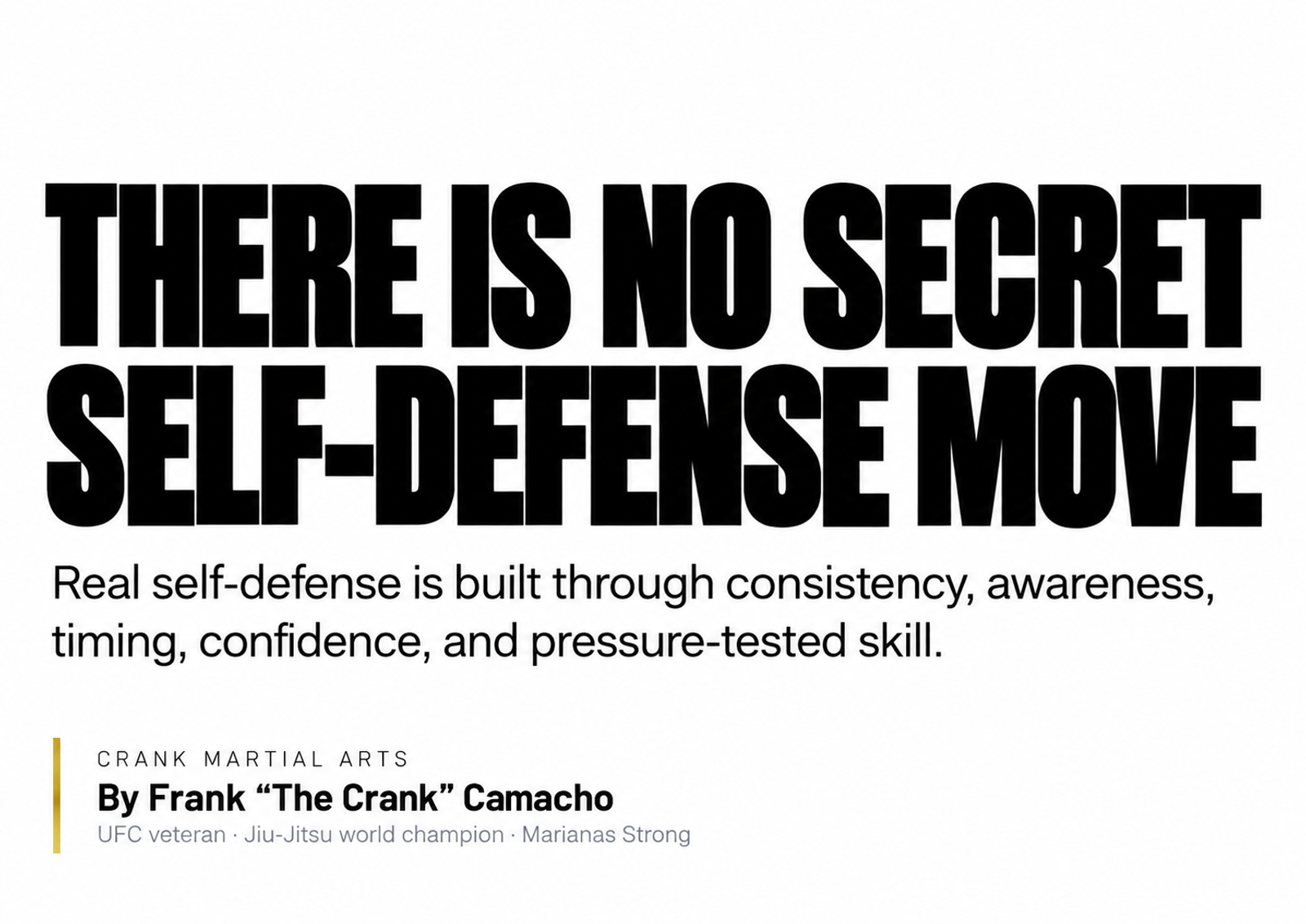
People love the idea of a secret technique.
Show me what to do if somebody grabs my wrist.
Show me the pressure point.
Show me the move that drops somebody instantly.
I understand why that's attractive.
But after spending most of my life training martial arts and eventually fighting professionally, I believe real self-defense works differently.
There isn't a collection of five secret techniques that suddenly makes somebody capable of defending themselves after one afternoon.
Because a real person doesn't cooperate with your technique.
They're moving.
They're resisting.
They might be stronger than you.
You're scared.
Your heart rate goes up.
Your thinking changes.
That's why consistency is such an important part of martial arts.
Every time you train, you're developing things that aren't as obvious as learning a submission or takedown.
You're developing balance.
Timing.
Awareness.
Distance.
Body control.
Decision-making.
You're learning how to stay calmer while somebody else is putting pressure on you.
You're learning what another person's body feels like when they're actually resisting you.
I sometimes think of this as the invisible side of martial arts.
You can't always point at it like a technique.
But after months and years of training, it's there.
Someone grabs you and you don't immediately panic.
You understand how to create space.
You understand your balance.
You recognize when a situation is becoming dangerous.
And maybe most importantly, martial arts should also teach you that the smartest fight is often the one you avoid completely.
That's why I believe self-defense needs consistent practice.
We're not memorizing choreography.
We're developing human beings who can move, think and react under pressure.
At CRANK Martial Arts, that's a huge part of how I look at training.
Whether you're an adult or you're putting your child into martial arts, I want the skills they develop to go deeper than knowing a few moves.
I want them to develop confidence and awareness that stays with them outside the academy too.